

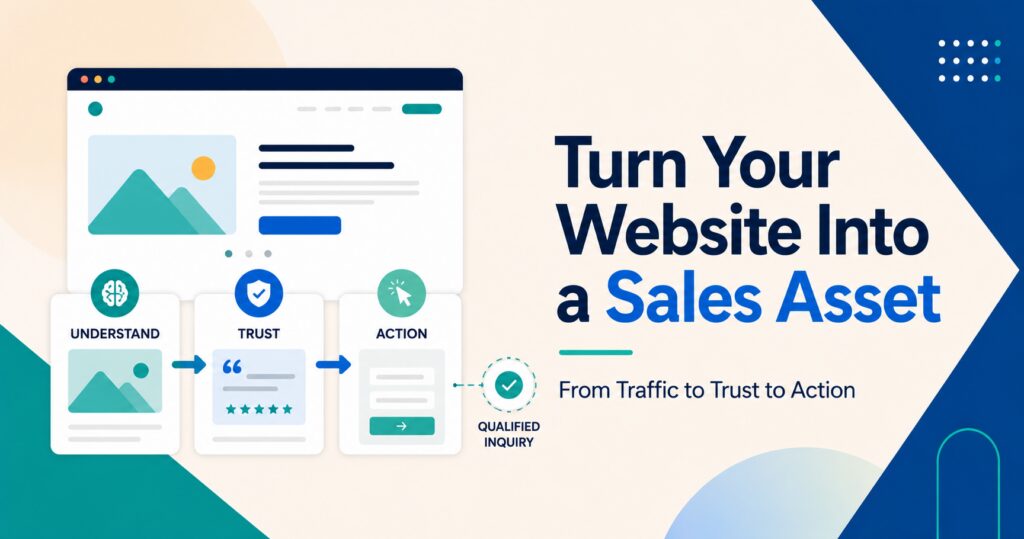
How to Turn Your Website Into a Sales Asset
Your website should do more than explain what your business offers.
It should help the right people understand the value, trust the company, take the next step, and move closer to a decision.
That does not mean every website needs aggressive sales language, constant popups, or a button in every paragraph. It means the site should support the sales process intentionally.
A strong sales website answers questions, reduces uncertainty, proves credibility, and makes action feel easy.
Start With the Buyer
Many websites are organized around the business instead of the person visiting it.
The navigation reflects internal departments. The homepage leads with company history. Service pages describe features without explaining why they matter. Calls to action assume visitors are ready to buy before the website has earned that decision.
A sales-focused website starts with the buyer’s situation.
Ask:
- What problem brought them here?
- What do they already understand?
- What are they uncertain about?
- What objections may stop them?
- What information do they need before contacting someone?
- What would make the next step feel lower risk?
The answers should shape the content, navigation, page structure, and calls to action.
The goal is not to push every visitor toward the same conversion. It is to help different visitors move forward from wherever they are in the decision process.
Make the Value Clear
Visitors should not have to interpret what the company does or why it matters.
Your core message should quickly explain:
- Who you help
- What problem you solve
- What you provide
- Why your approach is different
- What outcome the customer can expect
Generic language weakens the sales process.
Statements such as “innovative solutions,” “exceptional service,” and “results-driven strategies” sound positive, but they do not give buyers much to evaluate.
Specific language is more useful.
Instead of saying you provide customized solutions, explain what is actually customized. Instead of saying you deliver results, identify the results that matter. Instead of calling the team experienced, show the type of work they have handled and what that experience helps clients avoid.
A visitor should be able to understand the offer without translating the company’s language into their own needs.
Design for Decisions
Good design is not decoration. It helps people find information, understand priorities, and know what to do next.
A website becomes harder to use when:
- Navigation reflects internal structure
- Important information is buried
- Pages contain large walls of text
- Buttons compete with one another
- Visual hierarchy is weak
- Mobile layouts feel secondary
- Forms ask for too much too soon
Strong sales-oriented design creates a clear path.
That usually means:
- A focused page purpose
- Clear headings
- Short, useful sections
- Visible proof near important claims
- Logical calls to action
- Fast load times
- Accessible layouts and interactions
- A consistent experience across devices
The design should reduce mental effort, not add to it.
Visitors are more likely to continue when each section answers a question and naturally leads to the next one.
Build Trust With Proof
Most companies make similar claims.
They say they care about customers, deliver quality work, provide excellent service, and produce strong results.
Those claims become persuasive only when the website supports them with evidence.
Use testimonials well
Useful testimonials are specific.
They explain what the customer needed, what changed, and why the experience mattered. A vague compliment may sound nice, but it does not help a prospective buyer imagine the outcome.
Include the person’s name, role, organization, or other identifying context when permission allows. Anonymous praise carries less weight.
Show the work
Case studies can demonstrate:
- The original problem
- The constraints
- The strategy
- The work completed
- The measurable outcome
- What the client learned or gained
Even when exact numbers cannot be shared, the website can explain the challenge and the change.
Add trust where decisions happen
Proof should not be limited to one testimonials page.
Place relevant evidence near service descriptions, product details, forms, pricing information, and calls to action. The closer the proof is to the claim, the more useful it becomes.
Use Better Calls to Action
A call to action should match the visitor’s level of readiness.
“Contact us” may work for someone who has already decided to speak with the company. It is less useful for someone still comparing options or trying to understand the process.
A strong website offers different next steps, such as:
- Request a consultation
- View relevant work
- Compare service options
- Download a guide
- Check availability
- Get an estimate
- Ask a question
- Subscribe for updates
Each call to action should answer three questions:
- What will happen?
- What does the visitor need to provide?
- What should they expect next?
Clarity lowers the perceived risk of taking action.
Forms should also reflect the value of the next step. A newsletter signup may need only an email address. A complex project inquiry may justify more detail. Asking for unnecessary information creates friction before the relationship has begun.
Support the Full Journey
Not every visitor is ready to buy during the first visit.
Some are learning. Some are comparing. Some need internal approval. Some may return weeks or months later.
The website should support those stages with useful content.
That may include:
- Service explanations
- Buying guides
- Frequently asked questions
- Case studies
- Comparison pages
- Pricing guidance
- Process pages
- Educational articles
- Email resources
This content should help visitors make a better decision, not exist only to attract search traffic.
Useful content can also improve the sales conversation. When the website answers common questions in advance, sales calls can focus on fit, priorities, and next steps instead of repeating basic information.
Measure What Matters
Traffic alone does not tell you whether the website is supporting sales.
A sales asset should be measured against meaningful actions.
Depending on the business, those may include:
- Qualified inquiries
- Consultation requests
- Quote requests
- Product purchases
- Demo bookings
- Phone calls
- Email signups
- Resource downloads
- Return visits
- Movement between key pages
Analytics can reveal where visitors hesitate or leave.
Review:
- Which pages attract qualified visitors
- Which pages contribute to conversions
- Where forms are abandoned
- Which calls to action are used
- How mobile and desktop behavior differ
- Which sources produce real opportunities
- Which content supports later conversions
Do not optimize only for whatever metric is easiest to increase.
A page with less traffic may still be more valuable if it consistently attracts the right people and helps them take the next step.
Personalize With Care
Personalization can make a website more relevant, but it should solve a real problem.
Useful examples include:
- Showing different service paths by audience
- Highlighting location-specific information
- Recommending related products or resources
- Remembering practical user preferences
- Adapting content for returning customers
Personalization becomes less useful when it feels intrusive, relies on poor data, or makes incorrect assumptions about the visitor.
Start with clear audience paths and strong content before adding complex behavioral targeting.
A well-organized website often creates more value than an overengineered personalization system.
Treat the Website as a System
A website does not become a sales asset through one redesign or a few new buttons.
It requires alignment between:
- Brand positioning
- Website structure
- Content
- Search visibility
- Sales processes
- Analytics
- Follow-up
- Ongoing maintenance
If inquiries are ignored, forms break, pricing is outdated, case studies are years old, or sales teams do not know what the website promises, the system loses credibility.
The website should evolve as the company, audience, and offer change.
Review it regularly with practical questions:
- Does the message still reflect what we sell?
- Can buyers find the information they need?
- Are our strongest services easy to understand?
- Do our calls to action match buyer readiness?
- Are we proving our claims?
- Can we connect website activity to real opportunities?
Your website does not need to close every sale by itself.
It should make the next step easier, improve the quality of the conversation, and help the right people feel confident moving forward.
FAQs
FAQs
-
What does it mean to use a website as a sales asset?
A website becomes a sales asset when it helps prospective customers understand the offer, evaluate the business, resolve common concerns, and take a meaningful next step. It should support the sales process rather than function only as a digital brochure.
-
How can a website increase sales?
A website can increase sales by improving message clarity, making important information easier to find, demonstrating credibility, reducing friction, and offering calls to action that match the visitor’s readiness. It should also make follow-up and conversion tracking reliable.
-
What makes a website call to action effective?
An effective call to action clearly explains what will happen next and matches the visitor’s level of intent. It should use specific language, appear in a relevant context, and avoid asking for more information than the next step requires.
-
How should testimonials be used on a website?
Testimonials should be specific, credible, and placed near the claims or decisions they support. Strong testimonials explain the customer’s problem, the experience, and the result rather than offering only general praise.
-
Which website metrics matter most for sales?
Useful metrics include qualified inquiries, consultation requests, purchases, phone calls, form completion, resource downloads, return visits, and movement through important pages. Traffic provides useful context, but it should not be treated as the main measure of sales performance.
-
Does every website need personalization?
No. Personalization is helpful only when it improves relevance or reduces effort for the visitor. Clear audience paths, useful content, and a strong site structure should usually come before complex personalization technology.
